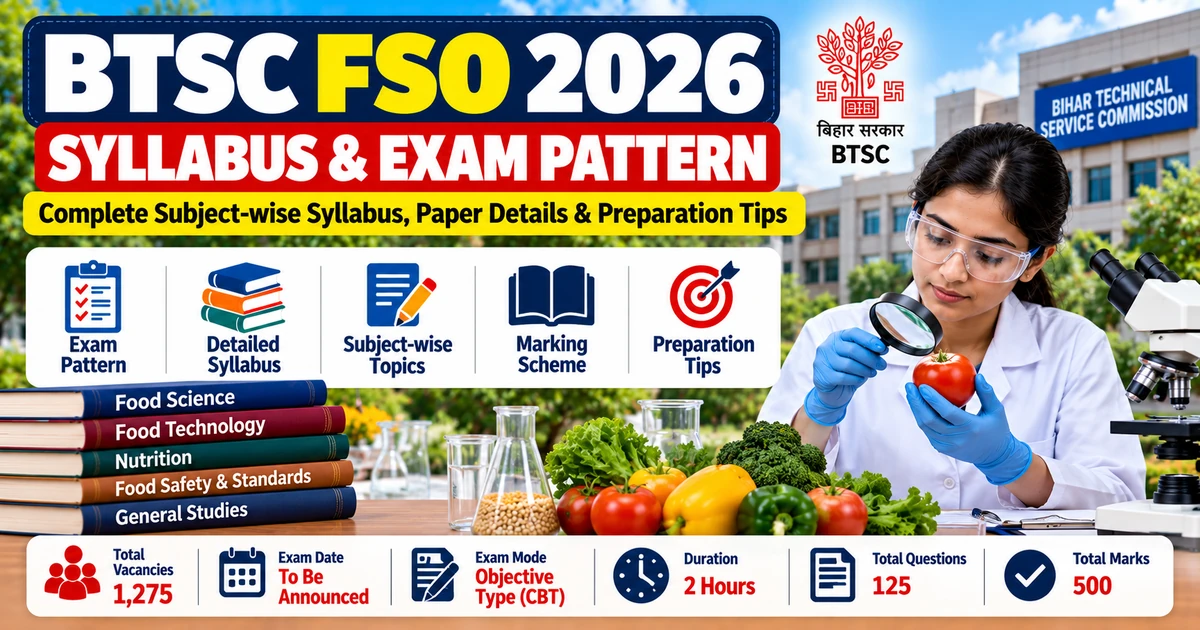
BTSC FSO Syllabus 2026 is essential for candidates preparing for the Bihar Technical Service Commission Food Safety Officer examination. The syllabus is largely technical because a Food Safety Officer is expected to understand food quality, food safety standards, microbiology, nutrition, processing, preservation, analysis and public-health aspects of food.
The published exam information describes the test as a Computer Based Test (CBT) containing 100 objective questions for 100 marks. Candidates receive 2 hours to complete the examination. The reported marking scheme awards one mark for a correct answer and deducts 0.25 mark for an incorrect answer. Therefore, preparation should combine strong technical knowledge with accuracy.
Table of Contents
BTSC FSO Syllabus 2026 Overview
| Exam | BTSC Food Safety Officer Examination 2026 |
|---|---|
| Conducting Authority | Bihar Technical Service Commission (BTSC) |
| Post | Food Safety Officer (FSO) |
| Exam Mode | Computer Based Test (CBT) |
| Question Type | Objective / Multiple Choice Questions |
| Total Questions | 100 |
| Total Marks | 100 |
| Exam Duration | 2 Hours |
| Marks for Correct Answer | +1 |
| Negative Marking | -0.25 for each incorrect answer, as per published pattern |
| Main Focus | Food Safety Officer technical subjects |
BTSC FSO Exam Pattern 2026
Understanding the exam pattern before beginning preparation helps candidates decide how much time to spend on concept-building and question practice. With 100 questions in 120 minutes, the average time available is slightly more than one minute per question. However, technical questions may require careful reading, so candidates should build enough speed to leave time for review.
| Particular | Details |
|---|---|
| Mode | Computer Based Test |
| Total Questions | 100 MCQs |
| Total Marks | 100 |
| Duration | 120 Minutes |
| Correct Answer | 1 Mark |
| Wrong Answer | 0.25 Mark Deduction |
| Question Nature | Objective |
BTSC Food Safety Officer Syllabus 2026 – Subject-Wise Topics
The technical syllabus can be organised into several major study areas. Candidates should use the detailed official BTSC syllabus as the final checklist and treat the following sections as a preparation framework.
1. Food Science and Nutrition
- Fundamentals of food science
- Composition and nutritional value of foods
- Carbohydrates, proteins and fats
- Vitamins and minerals
- Balanced diet and nutritional requirements
- Changes in food during cooking and processing
- Food quality and nutritional assessment
2. Food Microbiology
- Microorganisms associated with food
- Bacteria, yeasts and moulds
- Food spoilage
- Food-borne microorganisms
- Microbial growth and control
- Microbiological quality of food
- Sanitation and contamination control
3. Food Safety and Hygiene
- Principles of food safety
- Personal hygiene and food-handler hygiene
- Cleaning and sanitation
- Food contamination and cross-contamination
- Safe storage and handling
- Food-borne illness prevention
- Hazard identification and control
4. Food Processing and Preservation
- Principles of food preservation
- Heating and cooling methods
- Drying and dehydration
- Refrigeration and freezing
- Canning and packaging
- Use of preservatives
- Processing of major food commodities
- Shelf-life and storage
5. Food Chemistry and Analysis
- Basic food chemistry
- Moisture, ash, protein, fat and carbohydrate analysis
- Food additives
- Adulteration and contaminants
- Sampling concepts
- Laboratory analysis and interpretation
- Quality parameters for food products
6. Food Quality Control
- Quality assurance and quality control
- Good Manufacturing Practices
- Good Hygienic Practices
- Inspection principles
- Food-quality evaluation
- Documentation and records
- Risk-based food-safety concepts
7. Food-Borne Diseases and Public Health
- Food-borne infections and intoxications
- Common causative organisms
- Sources and routes of contamination
- Prevention and control
- Public-health importance of food safety
- Outbreak investigation basics
8. Food Safety Standards and Regulatory Concepts
A Food Safety Officer should understand the regulatory environment governing food businesses, inspections, sampling, compliance and enforcement. Candidates should study the legislation and standards specifically listed in the official BTSC syllabus and use current official regulatory material for provisions that can change.
BTSC FSO Topic-Wise Preparation Priority
| Area | Preparation Focus |
|---|---|
| Food Science & Nutrition | Concepts, composition and nutritional functions |
| Microbiology | Organisms, spoilage, food-borne disease and control |
| Food Safety | Hazards, hygiene, contamination and prevention |
| Processing | Preservation methods and commodity processing |
| Food Analysis | Testing concepts, adulteration and quality parameters |
| Quality Control | GMP, GHP, inspection and documentation |
| Regulatory Topics | Official food-safety laws, standards and enforcement concepts |
How to Prepare for BTSC FSO Exam 2026
- Start with the official syllabus: Make a checklist and mark every topic after completing it.
- Build technical concepts: Food Science, Microbiology and Safety should be understood rather than memorised blindly.
- Create short notes: Keep one-page revision sheets for pathogens, preservation methods, additives and analytical concepts.
- Practise MCQs: Objective practice is essential for converting theoretical knowledge into exam marks.
- Account for negative marking: Avoid excessive guessing when the final marking rule includes a 0.25 deduction.
- Take timed mocks: Practise 100-question papers within two hours.
- Analyse errors: Separate conceptual mistakes from careless errors and revise accordingly.
- Use current official material: Regulatory provisions and standards should be checked from authoritative sources.
30-Day BTSC FSO Preparation Strategy
| Period | Target |
|---|---|
| Days 1–7 | Food Science, Nutrition and Food Chemistry |
| Days 8–14 | Microbiology, Food-Borne Diseases and Hygiene |
| Days 15–20 | Processing, Preservation and Quality Control |
| Days 21–24 | Food Analysis, Adulteration and Regulatory Concepts |
| Days 25–27 | Complete revision and topic-wise MCQs |
| Days 28–30 | Full mock tests, error analysis and final revision |
Bihar SLET Salary 2026
BTSC FSO Notification 2026 PDF Download
BTSC FSO Syllabus 2026 FAQs
What is the BTSC FSO Syllabus 2026?
How many questions are asked in BTSC Food Safety Officer exam 2026?
What is the duration of BTSC FSO exam 2026?
Is there negative marking in BTSC FSO 2026?
How should I prepare for BTSC Food Safety Officer exam 2026?
Which subjects are important for BTSC FSO technical syllabus 2026?
Is the BTSC FSO exam conducted in CBT mode?
Important: Candidates should compare this preparation guide with the latest official BTSC Food Safety Officer syllabus and notification. If BTSC changes the examination scheme, subjects or marking rules, the official notice will prevail.