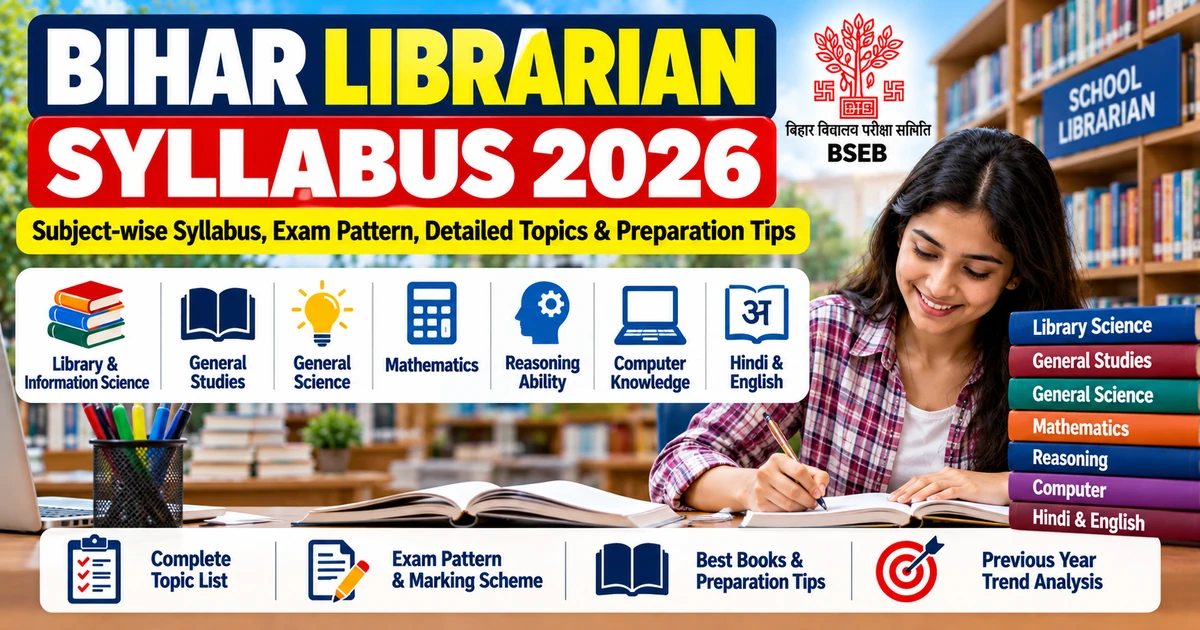
Bihar Librarian Syllabus 2026 is essential for candidates preparing for the Bihar School Librarian Eligibility Test (LET/SLET) conducted by the Bihar School Examination Board (BSEB). For the current 2026 eligibility-test cycle, candidates should prepare for a 150-question Computer Based Test carrying 150 marks. Library Science is the dominant section with 100 questions, while General Knowledge carries 50 questions.
The syllabus requires strong knowledge of Library and Information Science along with Bihar and national general awareness. Important Library Science areas include library foundations, Ranganathan’s Five Laws, management, classification, cataloguing, information sources and services, ICT, automation, digital libraries and research methodology. Candidates should also revise Bihar GK, current affairs, computer awareness, reasoning and basic aptitude topics relevant to the published syllabus guidance.
Table of Contents
Bihar Librarian Syllabus 2026 Overview
| Exam Name | Bihar School Librarian Eligibility Test 2026 |
|---|---|
| Conducting Authority | Bihar School Examination Board (BSEB) |
| Post | School Librarian |
| Exam Mode | Computer Based Test (CBT) |
| Question Type | Multiple Choice Questions |
| Total Questions | 150 |
| Total Marks | 150 |
| Duration | 150 Minutes |
| Negative Marking | No |
| Main Sections | Library Science and General Knowledge |
Bihar Librarian LET Exam Pattern 2026
The current School Librarian LET pattern gives two-thirds of the total marks to Library Science. Candidates should therefore make Library and Information Science the centre of their preparation while maintaining regular practice for General Knowledge and Bihar-related topics.
| Subject | Questions | Marks |
|---|---|---|
| Library Science | 100 | 100 |
| General Knowledge | 50 | 50 |
| Total | 150 | 150 |
- Each question carries 1 mark.
- Total examination time is 150 minutes.
- The paper is objective and computer based.
- The currently published pattern states that there is no negative marking.
Bihar Librarian Library Science Syllabus 2026
1. Foundations of Library and Information Science
- Concept, meaning and importance of libraries
- Types and functions of libraries
- Role of libraries in education and society
- Ranganathan’s Five Laws of Library Science
- Library legislation and development in India
- Professional library associations and institutions
- Library ethics and professional responsibilities
2. Library Management
- Principles of library management
- Library planning and organisation
- Collection development and acquisition
- Circulation systems
- Stock verification and weeding
- Preservation and conservation
- Budgeting, accounting and financial management
- Human resource management
- Library statistics and evaluation
3. Library Classification
- Meaning, purpose and principles of classification
- Notation and classification theory
- Dewey Decimal Classification (DDC)
- Universal Decimal Classification (UDC)
- Colon Classification
- Classification of different types of documents
4. Library Cataloguing
- Meaning and objectives of cataloguing
- Types and forms of catalogues
- Catalogue entries and bibliographic description
- AACR2 and cataloguing principles
- RDA and modern cataloguing concepts
- MARC and bibliographic standards
- Metadata and electronic cataloguing
- OPAC and online catalogues
5. Information Sources and Services
- Primary, secondary and tertiary information sources
- Dictionaries, encyclopedias and directories
- Bibliographies and biographical sources
- Indexing and abstracting services
- Reference and referral services
- Current Awareness Service (CAS)
- Selective Dissemination of Information (SDI)
- User education and information literacy
- Document delivery and inter-library loan
6. ICT, Library Automation and Software
- Computer fundamentals and computer networks
- Internet and web technologies
- Information and Communication Technology
- Library automation
- Integrated Library Management Systems
- KOHA, SOUL and e-Granthalaya
- Barcode and RFID technology
- Databases and electronic information services
7. Digital Libraries and E-Resources
- Concept and development of digital libraries
- Digitisation and digital preservation
- Electronic books, journals and databases
- Institutional repositories
- Open-access resources
- Information networks and resource sharing
- INFLIBNET, DELNET and related networks
8. Research Methodology and Bibliometrics
- Research methods and research design
- Data collection and sampling
- Quantitative and qualitative research
- Basic statistical techniques
- Report writing and citation
- Research ethics
- Bibliometrics and webmetrics
Bihar Librarian General Knowledge Syllabus 2026
| Area | Important Topics |
|---|---|
| Bihar GK | Bihar history, geography, culture, economy, rivers, personalities and important developments |
| Current Affairs | Bihar, national and international current events |
| History | Ancient, medieval and modern India; freedom movement |
| Geography | India and Bihar geography, climate, resources and agriculture |
| Polity | Indian Constitution, rights and duties, Parliament, executive and judiciary |
| Economy | Basic economics, budget, banking, taxation and development |
| General Science | Basic Physics, Chemistry, Biology and scientific developments |
| Culture | Art, literature, festivals, monuments and heritage |
| Other Awareness | Awards, sports, books, authors, personalities and government schemes |
Reasoning, Computer and Basic Aptitude Topics
Current Bihar Librarian syllabus guidance also highlights basic reasoning, computer and arithmetic areas. These topics should be prepared alongside the two main sections, especially where they are incorporated into the General Paper.
| Section | Topics |
|---|---|
| Reasoning | Analogy, series, classification, coding-decoding, blood relations, syllogism, direction, puzzles and analytical ability |
| Computer | Hardware, software, operating systems, MS Office, internet, email, networks, databases, cyber security and digital technology |
| Arithmetic | Number system, percentage, ratio, average, profit and loss, time and work and basic mathematics |
Bihar Librarian LET Qualifying Marks 2026
| Category | Qualifying Percentage |
|---|---|
| General | 50% |
| Backward Class (BC) | 45.5% |
| Extremely Backward Class (EBC) | 42.5% |
| SC / ST | 40% |
| PwD | 40% |
| Women | 40% |
Most Important Topics for Bihar Librarian 2026
- Ranganathan’s Five Laws of Library Science
- DDC, UDC and Colon Classification
- AACR2, RDA, MARC and cataloguing principles
- Library management, budgeting and collection development
- Reference sources and information services
- Library automation, KOHA, SOUL and e-Granthalaya
- Digital libraries, databases and e-resources
- INFLIBNET, DELNET and resource sharing
- Bihar history, geography, polity and current affairs
- Basic computer awareness and reasoning
Bihar SLET Notification 2026
How to Prepare for Bihar Librarian LET 2026
- Prioritise Library Science: It accounts for 100 of the 150 marks, so devote the largest portion of study time to it.
- Make classification and cataloguing notes: These areas contain many rules, terminology and standards that benefit from repeated revision.
- Revise Bihar GK daily: Maintain short notes for Bihar history, geography, schemes and current affairs.
- Practise objective questions: Convert each completed topic into MCQ practice.
- Use similar librarian papers: Because the current LET is newly introduced, relevant librarian examinations can provide useful practice.
- Take 150-minute mocks: Simulate the actual 150-question examination regularly.
- Analyse mistakes: Keep an error notebook and revise weak concepts instead of only counting mock-test scores.
- Revise repeatedly: Library standards, organisations, software, sources and factual GK require frequent revision.
Important Links for Bihar Librarian LET 2026
| Online Apply | Registration || Login |
|---|---|
| Official Website | Click Here |
Bihar Librarian Syllabus 2026 FAQs
What is the Bihar Librarian Syllabus 2026 for LET?
The current Bihar School Librarian Eligibility Test syllabus focuses mainly on Library and Information Science, along with General Knowledge and Bihar-related awareness. Preparation should also cover the computer, reasoning and basic arithmetic areas identified in current syllabus guidance.
How many questions are asked in Bihar Librarian LET 2026?
The current BSEB School Librarian Eligibility Test pattern has 150 multiple-choice questions for 150 marks: 100 questions from Library Science and 50 questions from General Knowledge.
What is the duration of Bihar Librarian LET 2026?
Candidates get 150 minutes, or 2 hours 30 minutes, to complete the 150-question examination.
Is there negative marking in Bihar Librarian LET 2026?
The currently published BSEB LET pattern states that there is no negative marking for incorrect answers.
Which topics are important in Bihar Librarian Library Science syllabus 2026?
Important areas include foundations of Library and Information Science, Five Laws, library management, classification, cataloguing, information sources and services, ICT, library automation, digital libraries and research methodology.
What should I study for Bihar Librarian General Knowledge 2026?
Prepare Indian and Bihar history, geography, polity, economy, current affairs, general science, awards, sports, books and authors, art and culture, government schemes and basic computer awareness.
What are the qualifying marks for Bihar Librarian LET 2026?
Published qualifying percentages are 50% for General, 45.5% for BC, 42.5% for EBC, and 40% for SC/ST, PwD and women candidates.
How should I prepare for Bihar Librarian Exam 2026?
Give the largest share of study time to Library Science because it carries 100 of 150 marks. Combine concept revision with MCQs, Bihar GK/current affairs, timed mock tests and repeated revision of classification, cataloguing and information-service topics.
Important: This article follows the current BSEB School Librarian Eligibility Test pattern for 2026. Candidates should use the detailed official BSEB notification and syllabus as the final authority if any subject, marking or examination rule is updated.