Beginner’s Guide to Index Funds: Simple Investing Strategy That Works: For decades, the investing world was dominated by the idea that skilled stock pickers and active fund managers could consistently beat the market. Academic research has steadily dismantled this belief.
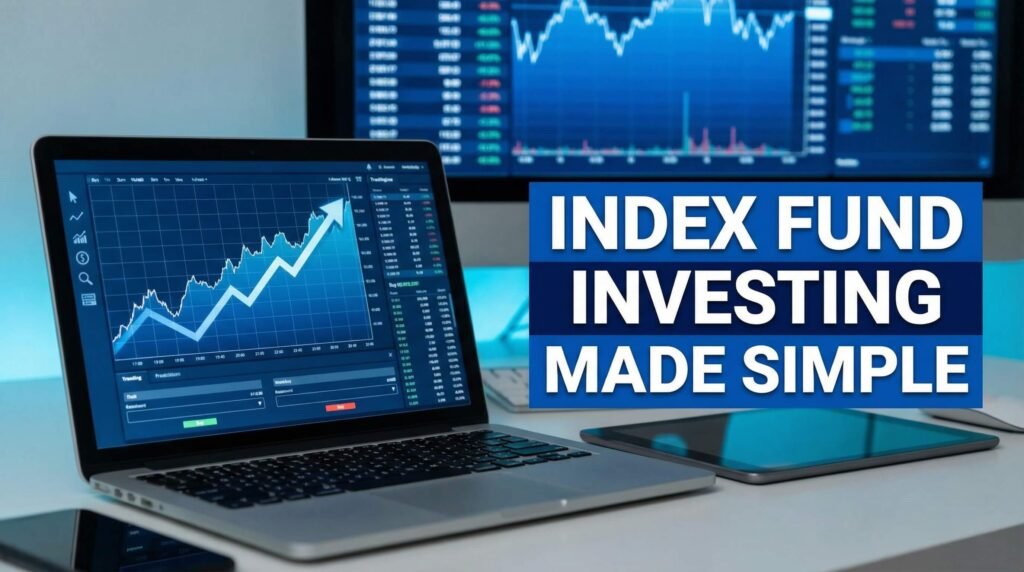
Study after study shows that the vast majority of actively managed funds underperform their benchmark index over the long run — often by a margin roughly equal to their fees. This insight gave rise to one of the most powerful investing tools available to everyday investors: the index fund.
Index funds are now at the center of the personal finance revolution. They are simple, low-cost, diversified, tax-efficient, and backed by decades of evidence. Understanding how they work and how to use them is arguably the most important investing knowledge an individual can acquire. This guide explains everything you need to know to get started.
What Is an Index Fund?
An index fund is a type of investment fund — either a mutual fund or an exchange-traded fund (ETF) — designed to replicate the performance of a specific market index. An index is a basket of securities that represents a particular market or segment of a market. The S&P 500, for example, is an index that tracks the 500 largest publicly traded companies in the United States. The total stock market index tracks virtually every U.S.-listed stock.
When you invest in an S&P 500 index fund, you are buying a tiny slice of all 500 companies in that index, in proportion to their market capitalization. As the collective value of those 500 companies rises, so does your investment. As it falls, so does your portfolio. The fund does not try to pick winning stocks or time the market — it simply holds the index.
Why Index Funds Are So Powerful
Diversification
Owning a single stock exposes you to catastrophic risk if that company fails. By owning hundreds or thousands of stocks through a single index fund, you eliminate what investors call unsystematic risk — the risk specific to an individual company. Broad diversification ensures that no single company’s failure can significantly damage your portfolio.
Low Costs
The expense ratio of an investment fund is the annual fee charged as a percentage of assets under management. Actively managed funds typically charge 0.5 to 1.5 percent or more per year. Index funds from major providers like Vanguard, Fidelity, and Schwab often charge 0.03 to 0.20 percent — sometimes even zero. Over decades, this cost difference is staggering. A one percent annual fee difference on a $100,000 portfolio over 30 years costs approximately $94,000 in lost returns, assuming 7 percent annual growth. This is the primary reason index funds consistently outperform actively managed funds over time.
Performance
The SPIVA (S&P Indices Versus Active) report, published twice annually, consistently shows that 80 to 90 percent of actively managed funds underperform their benchmark index over any 10-to-15-year period. The funds that do outperform tend not to repeat their success in subsequent periods. In other words, beating the market consistently is extraordinarily difficult even for professional investors with vast resources. Index funds guarantee you capture the market return — which has historically been very attractive over the long term.
Tax Efficiency
Index funds trade infrequently — they only buy and sell when the underlying index changes, which happens rarely. Frequent trading in active funds generates capital gains distributions that can be taxable even if you did not sell any shares. Index funds typically generate far fewer taxable events, making them more efficient in taxable brokerage accounts.
Types of Index Funds to Know
Total Stock Market Index Funds
These funds track the entire U.S. equity market, including large-, mid-, and small-cap stocks. Examples include the Vanguard Total Stock Market ETF (VTI) and the Fidelity Zero Total Market Index Fund (FZROX). They offer the broadest possible U.S. equity diversification in a single fund.
S&P 500 Index Funds
These track the 500 largest U.S. companies and represent approximately 80 percent of total U.S. market capitalization. The SPDR S&P 500 ETF Trust (SPY), Vanguard S&P 500 ETF (VOO), and iShares Core S&P 500 ETF (IVV) are among the largest and most popular investment funds in the world. Historically, the S&P 500 has returned approximately 10 percent per year on average before inflation.
International Index Funds
Diversifying globally means owning stakes in companies outside the United States. International index funds track indices covering developed international markets (like the MSCI EAFE index) or emerging markets (like the MSCI Emerging Markets index). Global diversification reduces dependence on the U.S. economy and provides exposure to faster-growing economies.
Bond Index Funds
Bond index funds provide exposure to fixed-income securities including U.S. Treasuries, corporate bonds, and mortgage-backed securities. They play an important role in portfolio construction, particularly for investors nearing retirement, providing income and reducing overall portfolio volatility.
How to Start Investing in Index Funds
Open the Right Account
Your choice of account type determines your tax treatment. A 401(k) or 403(b) through your employer offers tax-deferred growth and often employer matching contributions — take full advantage of any employer match first, as it is an immediate 100 percent return on that portion of your investment. A Traditional IRA offers tax-deductible contributions and tax-deferred growth. A Roth IRA offers no immediate tax deduction but provides completely tax-free growth and withdrawals in retirement. For money you may need before retirement, a taxable brokerage account is flexible but less tax-advantaged.
Choose a Brokerage
Vanguard, Fidelity, and Charles Schwab are widely regarded as the three most investor-friendly brokerages for index fund investing. All three offer commission-free trading, access to low-cost index funds and ETFs, excellent educational resources, and strong customer service. Fidelity even offers several index funds with zero expense ratios.
Select Your Funds
For most beginning investors, a simple three-fund portfolio covers everything needed: a U.S. total stock market index fund, an international stock market index fund, and a U.S. total bond market index fund. The allocation between these three depends on your investment timeline and risk tolerance. A younger investor with 30-plus years until retirement might choose 70 percent U.S. stocks, 20 percent international stocks, and 10 percent bonds. An investor closer to retirement would shift toward more bonds for stability.
Invest Consistently
Dollar-cost averaging — investing a fixed amount at regular intervals regardless of market conditions — is the recommended approach for most individual investors. It removes the impossible task of timing the market, automatically buys more shares when prices are low and fewer when prices are high, and builds the habit of consistent investing. Automate your contributions and resist the urge to check your portfolio too frequently.
Common Mistakes to Avoid
Panic selling during market downturns is the most costly mistake index fund investors make. Markets have historically always recovered from downturns — but investors who sell during crashes lock in their losses and often miss the recovery. Stay the course.
Overcomplicating the portfolio is another common error. Adding dozens of sector funds, thematic ETFs, or actively managed funds on top of a core index fund portfolio introduces unnecessary cost and complexity without improving expected returns. Simple and consistent outperforms complex and active for most individual investors.
Finally, starting too late or waiting for the ‘right’ time to invest are expensive mistakes. The right time to invest is as early as possible. Time in the market — driven by the power of compound interest — is far more important than timing the market.
The Long-Term Case for Index Funds
A hypothetical investor who put $10,000 into an S&P 500 index fund in 1990 and reinvested dividends would have seen that investment grow to approximately $230,000 by 2025 — a 23-fold increase, achieved by doing essentially nothing beyond staying invested. This is the power of long-term compound returns combined with low costs.
Index fund investing will not make you rich overnight, and it requires the discipline to stay invested through inevitable market volatility. But for the vast majority of individual investors, it represents the optimal strategy: capturing the long-term growth of the economy at minimal cost, without the futile attempt to outguess professional traders and analysts.
Conclusion
Index funds democratize investing. They give every individual investor — regardless of wealth, knowledge, or time available — access to the same market returns that have historically built significant wealth over long time horizons. Open an account, choose low-cost index funds, invest consistently, and give your money time to compound. It is not complicated. It is not exciting. And it works.
Disclaimer: This article is for informational and educational purposes only and does not constitute financial, investment, or legal advice. Always consult a qualified financial advisor before making any financial decisions.